
Author: Clari5
Synchronized Enterprise Fraud Management + Anti-Money Laundering Strategy
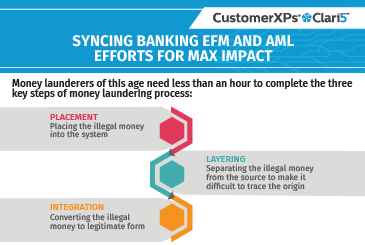
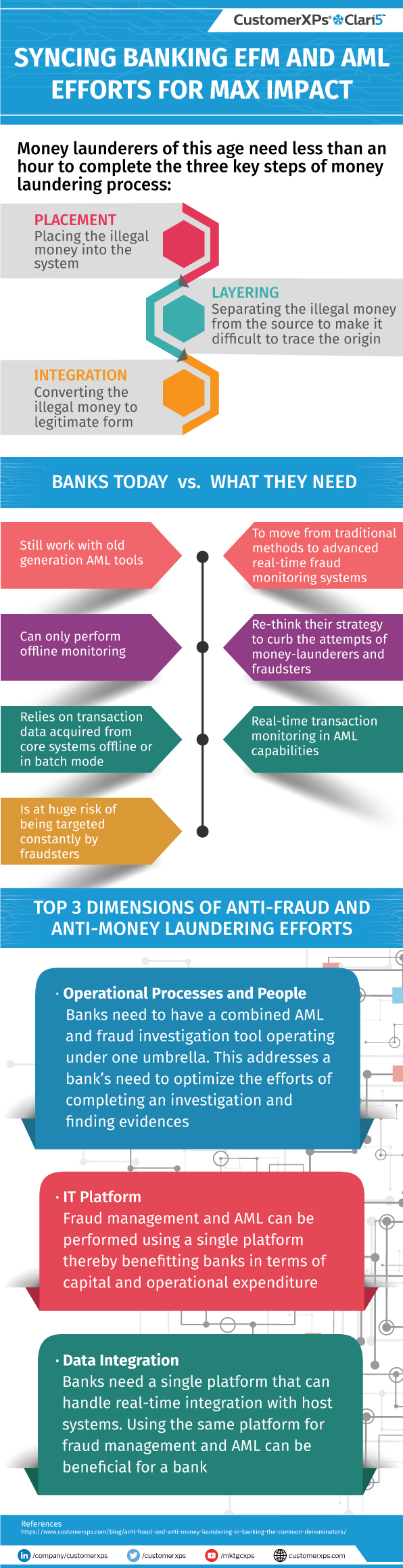
The conventional, compartmentalized and myopic approach to fraud is no longer a match for today’s savvy financial fraudsters. Banks need to consider the key dimensions of a well-synchronized, cross-channel, real-time EFM +AML to combat sophisticated new age financial crimes.
Changing the Customer Engagement paradigm: transforming 4500 bank branches with instant insights

Instant customer delight via intelligent, paperless branch banking for North American bank

Unified AML Compliance + Enterprise Fraud Solution on Single Platform Helps Leading Private Bank Combat Financial Crime in Real-time

Episode 4: Money Rolls

Our new series of thrillers – produced and directed by CustomerXPs and Banking Technology – narrate the tales of the fight between the forces of good (the Clari5 analytics and anti-fraud software) and the forces of evil. Based on real events and guaranteed to keep you on the edge of your seat!
Swish, swish, swish, a continuous untiring, unceasing sound like the rhythmic sound of a windshield wiper emanating in the room, unmindful of the busy bankers going about their daily business. Rows upon rows and columns upon columns of data were being swept, mined and recorded for activity and information.
Clari5 was at it again. Going about its daily chores, without a stop. Its human-brain like intelligence constantly on the lookout. For anything it could sink its teeth into. It loved anomalies. Strange fetish!

Clari5 will find you
On the 16th floor of the realty firm of Keller & Core, Sheenan was busy logging in some information. He could be closing an all-cash deal for that million dollar beach-front property in the Hamptons. His commission from that deal would be sizeable. He was looking forward to purchasing a new surf board and those boom speakers for his car.
His client, Ross, middle-40s, was a successful “antique dealer” and he knew exactly what he wanted. His clothes reeked of “designer”. The watch – a killer Patek Philippe, the wheels – a Jaguar XF, all screamed “serious money”, from a mile away. Sheenan and he hit the vibe and Sheenan liked Ross and the way he operated. Good money in antiques, he thought.
Ross pulled at his Fuente Don Arturo and thought about the next shipment. His mind kept going back to Sheenan.
“He could be a good bet. Small chunks about a couple of large ones, every second day. Hmm…”
Smoke from his cigar swirled as Ross continued to formulate his plan of getting Sheenan on his side.
Thursday, June 21, 7.30 am at the beach-front villa
“Good morning Mr. Ross. It’s a beautiful day. The view is spectacular in the morning.”
“Hello Sheenan. Thank you for coming out so early.”
“No problem, Mr. Ross.”
“Hope you had time to think it over, Sheenan. Old could be gold if you wanted it.”
Sheenan smiles and shakes hands with Ross. The deal is done. He rubs his hands in silent glee as old is now going to turn into gold for him.
Tuesday, June 26, 10.47 am
Ping. Sheenan Cooper – deposit of $3,000 in salary account.
Thursday, June 28, 11.03 am
Ping. Sheenan Cooper – deposit of $3,000 in salary account.
Saturday, June 30, 11.03 am
Ping. Sheenan Cooper – deposit of $4,000 in salary account.
Pause.
Clari5 paused. $3,000–4,000 on alternate days. Clari5’s artificial intelligence (AI) picked up these kind of anomalies. Quick check-through of previous deposits’ data on the account, behaviour pattern studies, little bits of information filed for over the last six months on Sheenan Cooper. Nyet! No such anomaly. Clari5 makes a decision – time to notify. Sheenan Cooper, red “flag”. Suspicious.
“Thank God for ambitious kids like Sheenan – so damned easy to get them to do your bidding. This deal and deed’s done. And good thing banks don’t have eyes at the back of their heads”, thought Ross.
Monday, July 2, 10.05 am
The bank’s fraud and AML supervisor Jim pauses, crinkling his forehead trying to remember. The report has a “red flag” against a few but one that stands out is Sheenan Cooper.
That young, bright blonde kid that Keira had introduced seemed so positive and earnest. “$10,000 in over three days? What the hell is going on?” Jim is bemused.
Jim filed a suspicious activity report (SAR) against Sheenan. This was a mandate by FinCEN for any deposits of $10,000 in any account. “Poor kid! Wonder what he’s got himself into?” Jim thinks to himself.
October 17, 6.15 am, Sheenan’s apartment
“What’s going on, officer? What’s all this about?”
“Sheenan Cooper! You are under arrest for money laundering and aiding and abetting illegal siphoning of funds. You have the right to remain silent…”
“Whoa, whoa, whoa! What? But Ross Palanik was the guy… what about going after the big fish, have you spoken to him?”
“He’s being handcuffed as we speak and being taken for questioning.”
Swish, swish, swish, a continuous untiring, unceasing sound like the rhythmic sound of a windshield wiper emanated in the room. Rows upon rows and columns upon columns of data were being swept, mined and recorded for activity and information. An occasional ping disturbed the swish.
Clari5 was at it again. It loved anomalies. Strange fetish!
March 2017 Issue

Interview: The Power of ‘Segment of 1’
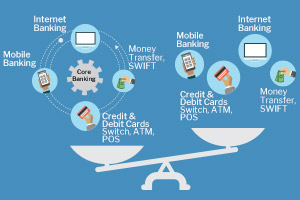 White Paper: Core Banking led vs Alternate Delivery Channel only Approach for tackling Enterprise Fraud
A Core Banking led fraud detection approach delivers 5 compelling advantages over silo-ed Delivery Channel based systems mainly depth of analysis, ease of configuration/implementation, cross channel fraud detection, insider fraud detection and real-time high availability. Read More
Blog: Countering Card Fraud. Is Chip & Pin Technology Enough?
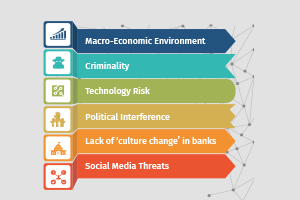 Infographic: Trends Threatening Banking
The Power of ‘Segment of 1’

Read how the theoretical concept of ‘the segment of 1’ can be practically applied in real-time for fighting fraud as well as maximizing customer revenues intelligently. Read how precise, real-time contextual interventions using the ‘segment of 1’ concept helps banks and how the CustomerXPs product Clari5 is engineered to address the need.
Read More
February 2017 Issue

How To Monetize your Anti-Fraud Solution to Make Money for your Bank
 ‘Money Rolls’
The next episode in the financial fraud thriller series based on Clari5 product use-case scenarios, co-produced and directed along with Banking Technology magazine. Read the previous episodes – Read More
Ep 3: Inside Job
Ep 2: Blacklisted
Ep 1: Malafide Intentions
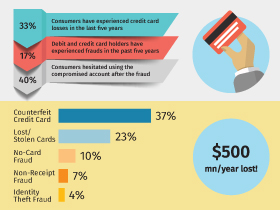 Infographic: Credit Card Frauds 101
 Clari5 Case Study: Real-time AML for Prominent Bank
Countering Card Fraud: Is Chip & Pin Technology Enough?

 EuroPay, MasterCard and Visa (EMV) is a technical standard developed to ensure more secure Point-Of-Sale (POS) transactions. EMV allows non-static information to be transferred between the card, the terminal, and the financial institution that processes credit card transactions. This takes care of skimming fraud where fake devices would copy data from magnetic stripes and use it on another card. While EMV is not new technology and has been in use for over a decade, it has made its way to the US in the last 2 years.
How does EMV Technology work?
EMV uses microprocessor chips that encrypt bank information making it far more secure than the old magnetic stripe cards. Magnetic Stripe uses static data that is stored in the stripe on the card (this makes it unsafe considering it can be stolen and used). The static information means that the number transmitted by the card for all transactions is the same.
 When it comes to EMV standard, although the card data will be the same for every transaction, there will also be other pieces of data that gets re-organised for every transaction. This renders the data stolen at the POS useless for further use.
The verification method for EMV cards can be chip-and-pin or chip-and-signature, with the former being the preferred choice in Europe and the latter often used in the US. This is contactless transaction which is becoming popular as NFC (Near Field Communication) technology used by mobile payments is making inroads. While technological advancements are racing ahead to reduce frauds, fraudsters are not far behind, as they continue to seek innovative methods.
Fraud, the scare still exists
While POS frauds and card counterfeiting have reduced in countries that are early EMV adopters, the cybercrime scene has now shifted to the canvas of e-commerce and online transactions. Fraudsters are also keenly watching late EMV adopters as potential targets. With data breaches and online theft increasing, security agencies have reported a doubling in crime rates of online frauds. ATM frauds are not far behind – swindling with counterfeiting cards and duping to snatch PIN numbers are on the rise.
Research analysts report that these types of frauds are more damaging to the customer by the day. The frauds go unnoticed as the unauthorised purchases and withdrawals lie hidden in the transactional details list. Not many customers go through their transaction histories regularly and closely.
The microchip comes into play when trying to prevent counterfeit fraud because it makes it harder to produce a copy of the card. And a PIN comes into play for protecting against lost-or-stolen fraud because it makes it impossible to use the card unless they also know the PIN.
EMV adoption and the changing fraud types
 Using EMV technology for cards has seen a reduction in skimming-type attacks, but the crime rate has increased in other ways of stealing money. Research firm Aite Group reports that losses from counterfeit, lost, and stolen cards in Canada dropped from $245 million in 2008 to $112 million in 2013.
A research by the European ATM Security Team (EAST) found that fraud-type attacks increased 28% during the first half of 2016 with cyber criminals stealing €174 million and Aite reported that there was a 79% increase in online fraud during the EMV adoption phase in Europe.
The banking sector is now making a move to bring in EMV-chip-enabled credit and debit cards, which generate a unique transaction code with each purchase, making them harder to spoof. With these systems and cards rolling out, mining credit card numbers will not be as valuable for criminals, says Privacy Rights Clearinghouse.
Precautionary steps

While fraud severely erodes customer confidence and the bank’s bottom line, fraudsters continue to keep pace with the very technologies that are being developed to keep them at bay.
While banks conduct frequent security audits, invest in advanced security measures and work proactively in mitigating risks, there’s no silver bullet that can eliminate fraud completely.
However, it does help to have an intelligent, pro-active, well-synchronised cross-channel system in place that –
- Understands customers’ transaction patterns at a granular level using information from across all channels
- keeps track of customers’ credit histories
- screens transactions in real-time to quickly spot unusual / potentially suspect activity
- applies login authentication rules (including mobile number / email id updates)
- activates real-time alerts and notifications while potentially suspect transactions are in progress
To effectively combat fraud, Banks must go beyond conventional anti-fraud solutions. Intelligent platforms are now available that harness data in real-time from across channels to not only deliver a unified anti-fraud mechanism but also helps create a secure ecosystem.